Warren Kipner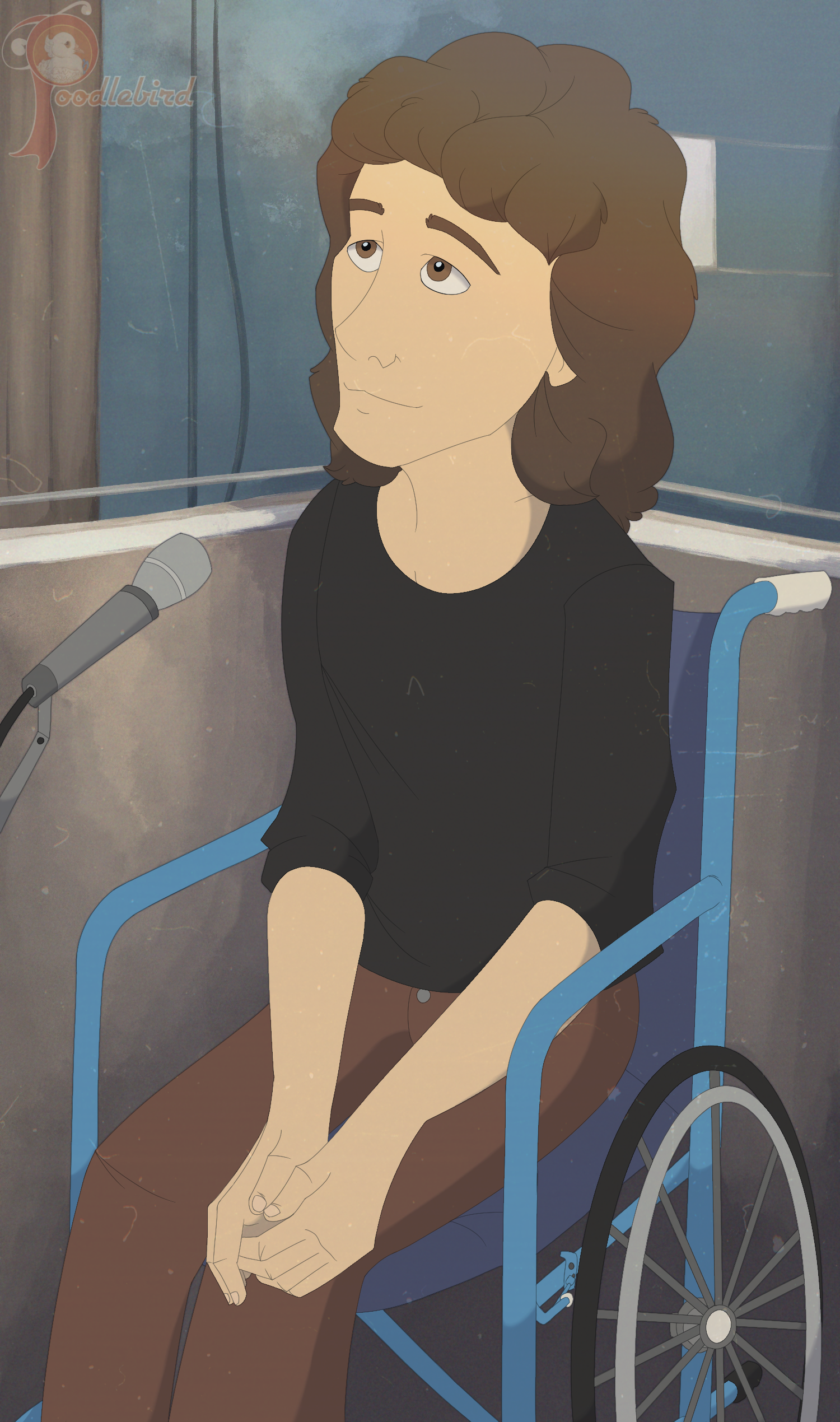
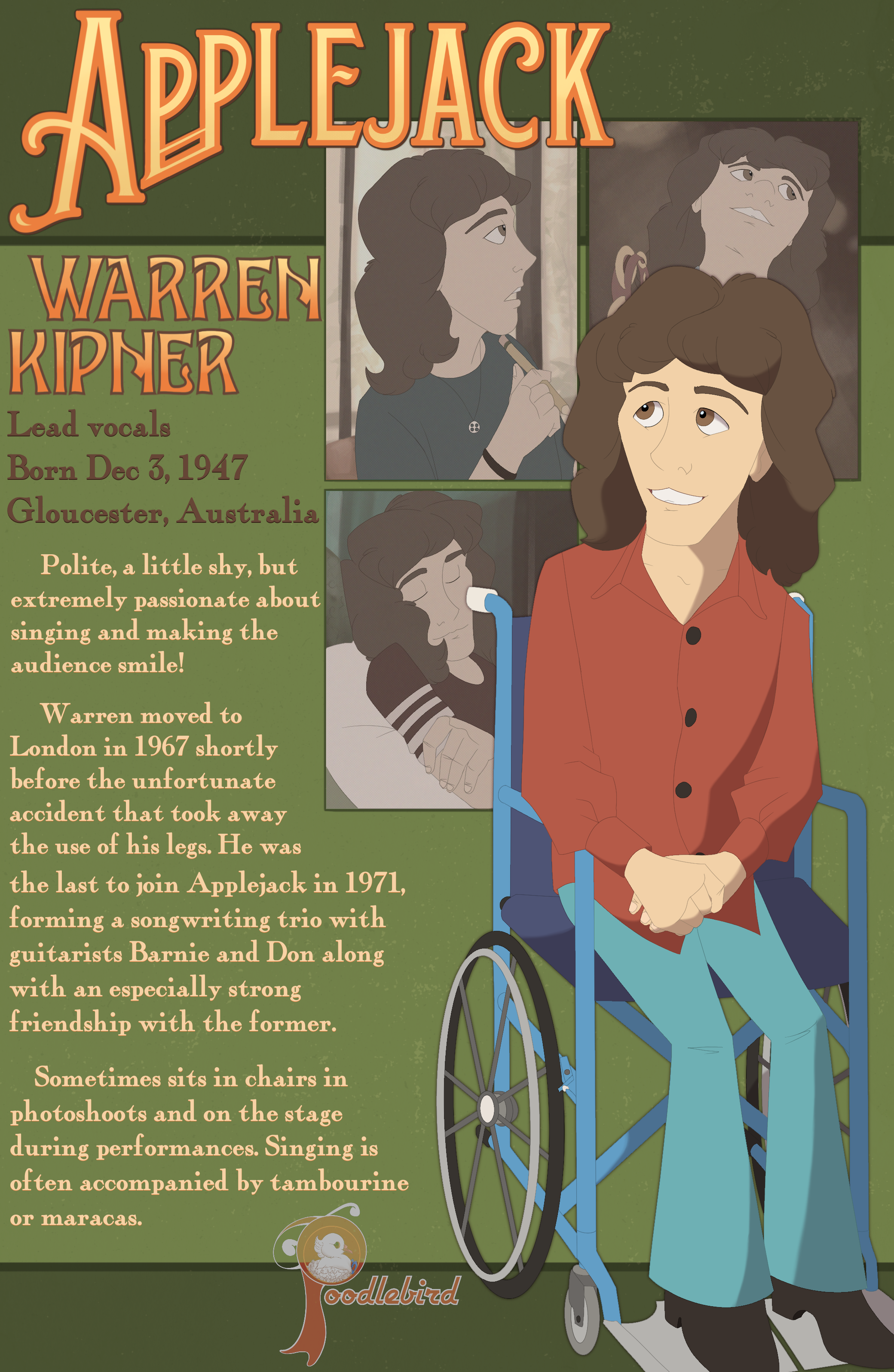
Warren Kipner is the powerful, energetic voice of Applejack, an English pop group that began in 1971. Onstage, he typically plays tamborine or maracas while singing. Then when the show's done, he works with Barnie Sinclair and Don Collings to write the band's next hit. It was their first original single, Everybody Shake, that skyrocketed the group into national fame.
Unlike the rest of the group, however, Warren was born and raised in Australia. Shortly before joining Applejack, he was involved in an unfortunate accident that left him paralyzed from the waist down. But with his own determination and some help from the rest of the group, he's able to tour with them all over England!
Personality:
Offstage, Warren is known for his polite character- a little shy, maybe, but easygoing and always in the mood for a lighthearted joke. Although he loves singing and songwriting at its core, he truly thrives off of making his audience smile and dance. As a result, he's very grateful for the success of Applejack and couldn't ask for anything more.
His journey to stardom wasn't easy, however. Even now, he's constantly facing hardships from being disabled. But he usually hides his darker emotions from both the public and his bandmates. He even allows for a pushy question every now and then, sometimes laughs away a joke that secretly bothered him, and tries to ask for help only at the last possible moment. After all, he never asked to be paralyzed. The more people who can see him for who he is, the better.
Stories:
Other Art:


-
A Deeper Look
Backstory
Warren Kipner was born on December 3rd, 1947 in Gloucester, a small town in New South Wales. Although he was an only child and never knew his father, he was strangely introverted for a boy and could keep himself entertained, or so his mother always saw it. Lisa Kipner, who jumped between various odd jobs, was extremely protective of him but took him to the nearby beach when she had the time. Going into school, he performed just above the mark by age six and didn't have any friends until, one day, a new student showed up to class and was seated next to him. Rob Henson was an extremely gifted and popular kid, but something about Warren interested him and they struck an oddly close bond. Pretty soon they were doing everything together.
Years later, Rob would invite Warren over to show him his first rock n' roll record. At this time, Warren was quickly rising to the top of his school's swim team and Lisa was frustrated by this sudden distraction from his success. It wasn't long before Warren started getting his hands on his own records and even writing his own songs. Over his guitar, Rob spoke of leaving Australia to form a duo, just the two of them. Warren was hooked.
But Lisa had different feelings towards the proposal. London seemed worlds away, too far to watch over her baby boy, and something about his friend rubbed her the wrong way. After much diligence, though, she reluctantly agreed to let him go. By then, Rob had already packed and planned everything. They took a cab down to Sydney and took the first flight to London on October 16th, 1967. Warren was only 19 at the time, mostly relying on Rob's confidence for reassurance. But as soon as they acquired their rickety first apartment, the days were filled with exploring the fast, grand city and the nights were filled with local rock n' roll shows, all the time bustling among young people like themselves.
One of these young Londoners was a man named Barnie Sutton that Warren had chanced upon at a concert. They quickly hit it off, bonding over their shared dream of starting their own band. Warren was, however, still tied to Rob and their goal seemed closer than ever now. But things were not meant to last.
In a matter of months, Rob began to change. Suddenly, good old rock and roll seemed to matter less and less to him. In its place, he went on long tangents about society at large, the war, and this apparent new wave of music. Music, not just for listening, but driven to make a difference in the world. By 1968, these changes were getting harder to brush off. Rob grew his hair out, started wearing beads and brightly-colored kaftans, but more importantly, he drifted away from Warren. With each concert that Rob refused to join Warren at, they began to resent each other more and more.
Then came that stormy April night of 1969. Rob was driving Warren home from a local show that he once again went alone to. And for the first time in a long time, the tense air was broken with another argument about the purpose of music. As Rob took a shortcut to their apartment, however, a car suddenly drifted towards them from the other lane. In a panic, Rob turned the wheel. The rest of the night was a blur.
The next thing Warren remembered was drifting in and out of consciousness in a room of blinding white. Little by little, the details were revealed to him. Rob didn't make it. Moreover, something was wrong with Warren that they couldn't figure out. He couldn't move or even feel anything from the waist down, but unable to handle any more bad news, he tried to convince himself that he'd recover. These doctors were trained. They'd figure something out, wouldn't they?
Just as the nurses were preparing to give him the news, though, a woman claiming to be his mother burst into the hospital. When she was led to his room and left alone with him, she wouldn't even look him in the eye. Tears mixed with eyeliner streamed down her cheeks as she cried out this is all my fault. In her guilt, she ran out the door, never to return to England. A few hours later, the doctors finally gave the hurt and confused Warren the results of their findings of which Lisa had already been aware of. The damage to his spine was permanent. He would never be able to walk again. With it went his dream of ever becoming a singer, or so it seemed.
By 1971, he had long moved back into his apartment (which was conveniently on the ground floor) and eventually well enough physically to not need a nurse checking in on him twice a week. His mental health, on the other hand, had reached an all-time low. He lived off of cheap frozen food, lost several pounds, and hardly left his bed. Trying to do basic tasks like showering or getting dressed only reminded him that he was paralyzed forever. Looking at the tiny living area only reminded him of the man that used to be there, the man he never made things up with. Why had he survived, and Rob hadn't? Why couldn't he have died, too, instead of living like this?
Only one person in the world hadn't lost hope. With the help of the band he was beginning to piece together, Barnie was finally able to get Warren's whereabouts and piece together what had happened. But nothing could've prepared him for the man's state and the fact that nobody else had bothered to check in on him in all that time. There wasn't much Warren could do to fix himself before Barnie picked him up to talk in the back of a faraway diner. Naturally, the conversation turned towards Barnie's band and he expressed his need for a lead singer that could write songs. At first, Warren refused, not wanting to be a burden on them while better singers waited their turn. But Barnie was patient.
A few days later, Warren reluctantly agreed to tag along with Barnie on a trip to the barber before meeting the rest of the band. Andy Foss and Gabe McDowell were two that Warren had been briefly introduced to already before the incident. Only Don Collings was new. To all of them, the singer appeared fairly happy despite his circumstances and recording of their first demos quickly began.
After finally getting accepted by a small label under the working name "Warren & Friends", they went out to a small pub to celebrate. It was there that they landed on the new name "Applejack", although nobody knows who thought of it first. Despite their love and eagerness, though, their self-titled album would release in June of 1971 to little fanfare. It was a charming pop album, a little rough around the edges, but well-versed in both fun, energetic tunes and soft ballads written mostly by Warren, Barnie, and Don. It simply fell through the cracks as many debuts do. In desperation, the record label demanded that the band put out a rock n' roll dance tune as their first single. The newly-realized songwriting trio created "Everybody Shake" in just under thirty minutes. Had it not been for many laughing fits and kicks, they probably would've had it done in ten. But after the promotional discs were sent out, that little rock n' roll dance tune became a national hit overnight. It wasn't long before they were invited to perform it on a big television show. There was just one problem. Their singer couldn't dance.
The band had tried to keep Warren's disability under wraps as much as they could. Every promotional photo until now featured him sitting on the floor or on a chair, often with other members sitting as well. When it came to the moving picture, however, there wasn't much they could do. They could only sit their singer at the edge of the middle stage platform, hand him a tambourine, and hope for the best. While the song was successful on its own, what the band thought would be a liability would have the opposite effect. Viewers at home were taking note. There was obviously something about that singer- a reason that he wouldn't stand up once during the performance, not even to bow.
As soon as a reporter got Warren to admit that he couldn't feel his legs, the public was hooked. For a while, things kept going up. Their next album, "Second Batch", broke the charts in 1972 and was followed by an extremely successful tour across England. Warren's dream was finally coming true.
But the dream slowly began to morph into something much darker as the years went on. The way magazines described him, the sometimes pushy questions that interviewers asked... Was it really the music that drew people to Applejack? Or was it just the novelty? At least the fans saw him for who he truly was. Or at least, he thought so until Dottie came along, acted like they were good friends, cornered him in her hotel room...
After a sudden one year hiatus, Warren had changed. He was no longer the modest, innocent young man with wavy hair that Applejack knew. He had a frizzy perm surrounding his gaunt face, tight revealing clothes over his muscled arms and hairy chest. But more than that, he was cold, assertive, bitter. It wasn't just the turning into the late '70s that had changed him. The band could all tell, but no amount of picking and prying would get him to admit what had happened that night with Dottie. He simply didn't want to be a teenybopper anymore. He wanted to be taken seriously. This time, he'd make sure that the whole world would recognize his agency.
And over time, this obsession would go even further, fueled by a mysterious "Dr. Webb" who claimed to be on the brink of an important psychological breakthrough. For Warren, simply changing his image was not enough. He needed to change his entire mind and, in turn, his body. He needed his disability gone.
Flaws
Between him and Rob, Warren was always the "plain" one. He nevertheless wondered why everyone seemed so attracted to Rob but never him. Throughout his youth, he hardly made any friends beyond that one. The truth was, most people saw him as boring. By all means, Warren was kind, avoided conflict, and had an endearing love for songwriting. Having grown up as isolated as he did, however, he never learned to be funny or clever. He rarely asked follow-up questions and his attempts at predictable jokes or small talk would often fall flat.
Moreover, he avoided conflict so much that he also avoided basic communication, choosing instead to hold resentment towards those he had an issue with. For Rob, their closeness made this resentment spill over a little bit with each argument. He thought Rob's ideas about music changing society were ridiculous. The whole psychedelic movement just seemed like a bunch of rich druggies refusing to work. One could say that the two once-friends represented two opposing extremes- neither of them wrong, neither of them completely right. But the unconscious influence of Warren's mother presented itself in his strict ideas about following the law. The people who were being harmed by the law probably did something to deserve it, anyway.
A mix of joining a marginalized group and becoming closer to Barnie began to slowly change these ideas, however. When it came to the band's public image, however, Warren was hesitant to say anything political. If he were to become like that, then he should've done it when Rob was still alive. Besides, he never asked to be disabled, so why should a simple pop singer be expected to go out and fight for them? He already knew his life wouldn't be easy. Some things were just the way they were.
As for Applejack, Warren was very easy to work with throughout their early years. He was kind, optimistic, and always willing to listen to the members' ideas. But returning from his sudden hiatus in the late '70s, everything changed. He was suddenly bitter and standoffish, rarely smiling or laughing at all. Any little thing would set him off and, music-wise, he took control over every detail as if it would grant him control over his image, too. If he wasn't willing to open up about his struggles when he put up a happier front, he certainly wasn't willing to open up now, not even to Barnie.